IB AI policy: how teachers authenticate EE and IA work
Teachers authenticate EE and IA work by knowing how it was made: they see it develop over time, read one draft, and check that the student can explain it. AI does not change that test. The IB allows AI if it is credited with the prompt and date, and says detectors cannot be the sole evidence.¹ ³
Cognity, an AI visibility platform for classrooms, records how students work with AI on an assignment. This post sets out what the IB's own documents say, page by page, and turns it into a routine for Extended Essay supervisors and IA teachers.
What does the IB expect when a teacher authenticates work?
Four things, set out in Appendix 6 of the IB Academic integrity policy under the question "What does the IB expect when a teacher checks the authentication box".¹
- The teacher has seen the work develop over time. IB coursework "is not designed to be completed in a single evening."
- The student can explain the work well enough to show they created it.
- The student is clear about what is quoted and what is their own, which is ordinary referencing.
- The quality is in line with what the teacher expects that student to produce.
If a teacher is not convinced the work is the student's own, it must not be submitted to the IB.¹ The scenarios document adds that the IB only expects teachers to make "their best efforts" here.²
What does the IB policy say about AI?
AI is allowed, but nothing it produces counts as the student's own work. The rules sit in the same appendix, added in the March 2023 update:¹
- AI is not banned. "The IB will not ban the use of AI software." (p.53)
- AI output is never the student's own. Work produced "even only in part" by AI tools is not regarded as their own. (p.54)
- It must be credited twice. In the body of the text and in the bibliography. Leaving it out is a form of academic misconduct. (p.54)
- The citation carries the prompt and the date the AI generated the text, and paraphrasing counts too. (p.55)
Which AI uses does the IB accept in coursework?
Research help is acceptable; AI doing the student's thinking or writing is not. The IB's guidance document Evaluating 13 scenarios of AI in student coursework gives a verdict for common cases, and these are the ones a teacher meets most:²
| Scenario | IB verdict |
|---|---|
| AI summarises key points and suggests references | Acceptable |
| AI summarises counter-positions | Acceptable |
| Student copies quotes AI found, without checking them | Not acceptable |
| AI develops the research question | Not acceptable |
| AI rewrites the student's essay | Generally not acceptable |
| AI "marks" the draft before submission | Not acceptable: it breaks the one-set-of-feedback rule |
| AI writes the reflection | Not acceptable: it "would constitute fabrication" |
| Student hides AI use that was otherwise correct | Not acceptable |
The same document says the focus is "not on 'correct citation' of AI but on being transparent", and that a short statement after the work describing how AI was used is enough when AI shaped the work without appearing in it.²
What changes with the 2027 Extended Essay?
More of the EE now happens in conversation with the supervisor. The guide for first assessment 2027 replaces the RPPF with the Reflection and progress form (RPF):³
- Three reflection sessions are mandatory, about 20 to 30 minutes each. The third is a short viva voce.
- The RPF holds one reflective statement of up to 500 words. Criterion E, now "Reflection", is assessed on that statement alone and is worth 4 of the 30 marks. A blank RPF scores zero on it.
- The supervisor reads and comments on one draft only, with no direct editing, then reads the final version and, with the viva voce, confirms its authenticity.
- On AI, the guide is direct: using AI "to write an essay that is then presented as your own is dishonest". AI material can be one of the student's resources, acknowledged and cited, and the guide warns that AI can "hallucinate".
The reflection is the one place where AI help is never acceptable. An AI-written reflection is fabrication, not a citation problem.²
Can you use an AI detector to check IB work?
Not as evidence on its own. The policy says the IB wants to avoid an "arms race" with AI tools, and that detectors will take a while to be "reliable enough to be the sole evidence".¹
What the IB offers instead is firmer ground for teachers. "Teachers do not need to 'prove' that artificial intelligence or someone else wrote the student's work", the scenarios document says, and the IB will support a teacher's right not to authenticate work they are unsure of. Where AI use is in doubt, it suggests a viva or oral quiz.²
What about the IA and TOK?
There is no separate AI rule in the subject guides. The Biology guide, used here as a typical DP guide, does not mention AI at all; the IA falls under Appendix 6 and the same authentication routine.⁶
- One draft. Teachers read and advise on one draft, without editing it. The next version is the final one.⁶
- Every student, not only the sample. Teachers authenticate the work of all students, not just the work sent for moderation.⁶
- TOK records three interactions. The TOK essay needs three formal recorded interactions on the TK/PPF, which the guide calls "important evidence" of authenticity.⁷
What evidence should a teacher keep?
Five things, and all of them are already part of the IB's own routine. The guide budgets three to five hours of supervision per EE student, sessions included, so the evidence has to come out of work that is already happening rather than extra checks:² ³ ⁴
- Plans and drafts, in order, with version history where the tool keeps it.
- The student's prompts, in their references, and the AI conversation as an annex for the teacher.
- The researcher's reflection space, which the 2027 guide strongly recommends.
- The three reflection sessions, with the viva voce as the final check.
- One draft, one round of written feedback, then authentication.
A student statement the school can adapt, in the shape the policy asks for:
AI use in this work
- Tool and date: (for example, ChatGPT, used 14 September 2026)
- What I used it for: finding sources / checking an argument / other: ______
- Prompts that shaped the work: listed in my references, with the full conversation attached as an annex
- Where AI-derived text or ideas appear: marked in the text and listed in the bibliography
- What I did not use it for: writing or rewriting my sentences, or my reflection
What does this look like in Cognity?
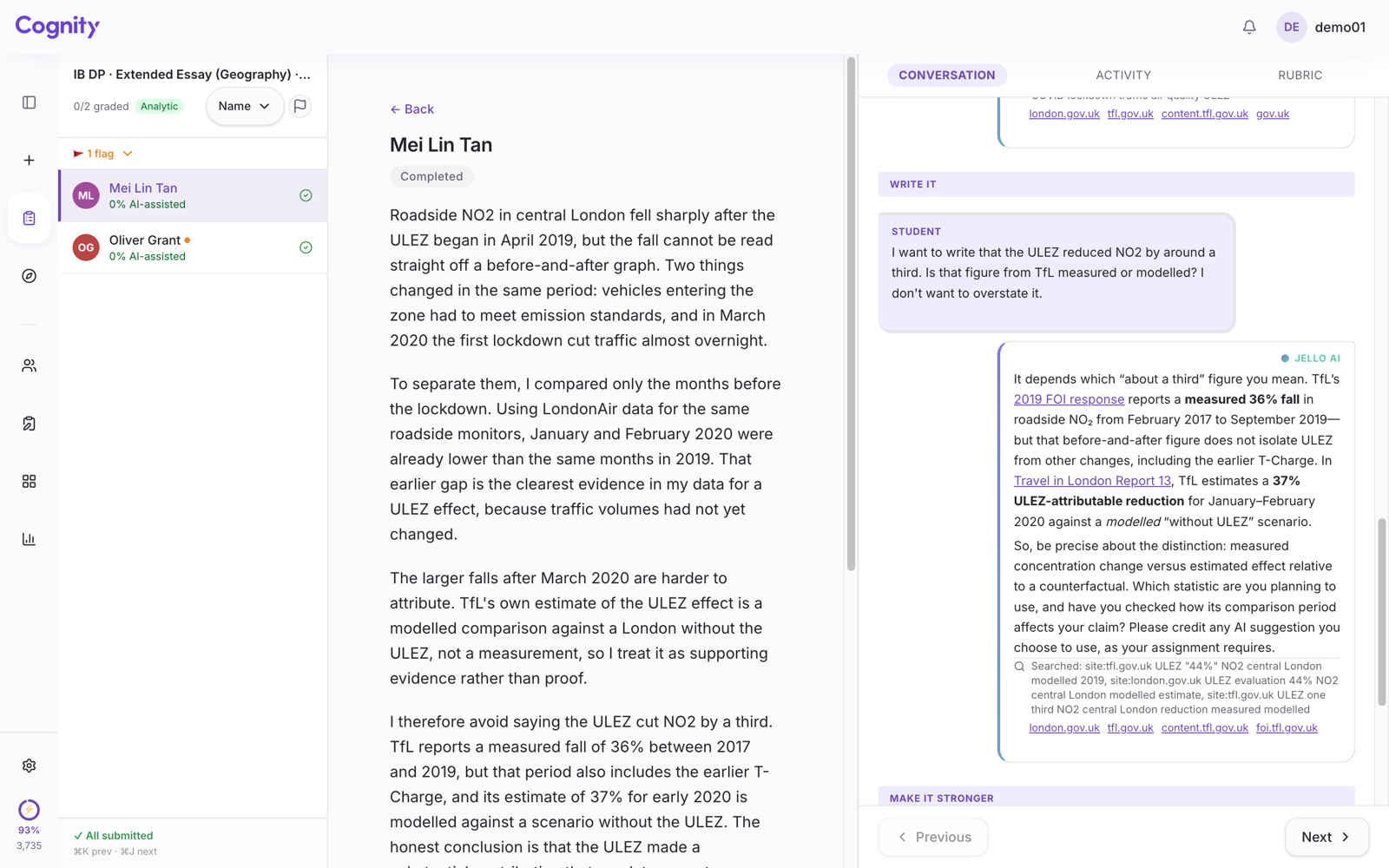
Students work on the assignment inside Cognity, with its AI tutor Jello following the AI rules the teacher sets. The conversation and the writing are recorded as they happen, so the annex the IB asks for exists without the student having to export anything.
The first student asked, halfway through the analysis, whether a TfL figure was measured or modelled before using it. Jello answered with the distinction and a reminder to credit any AI suggestion used, as the assignment required.
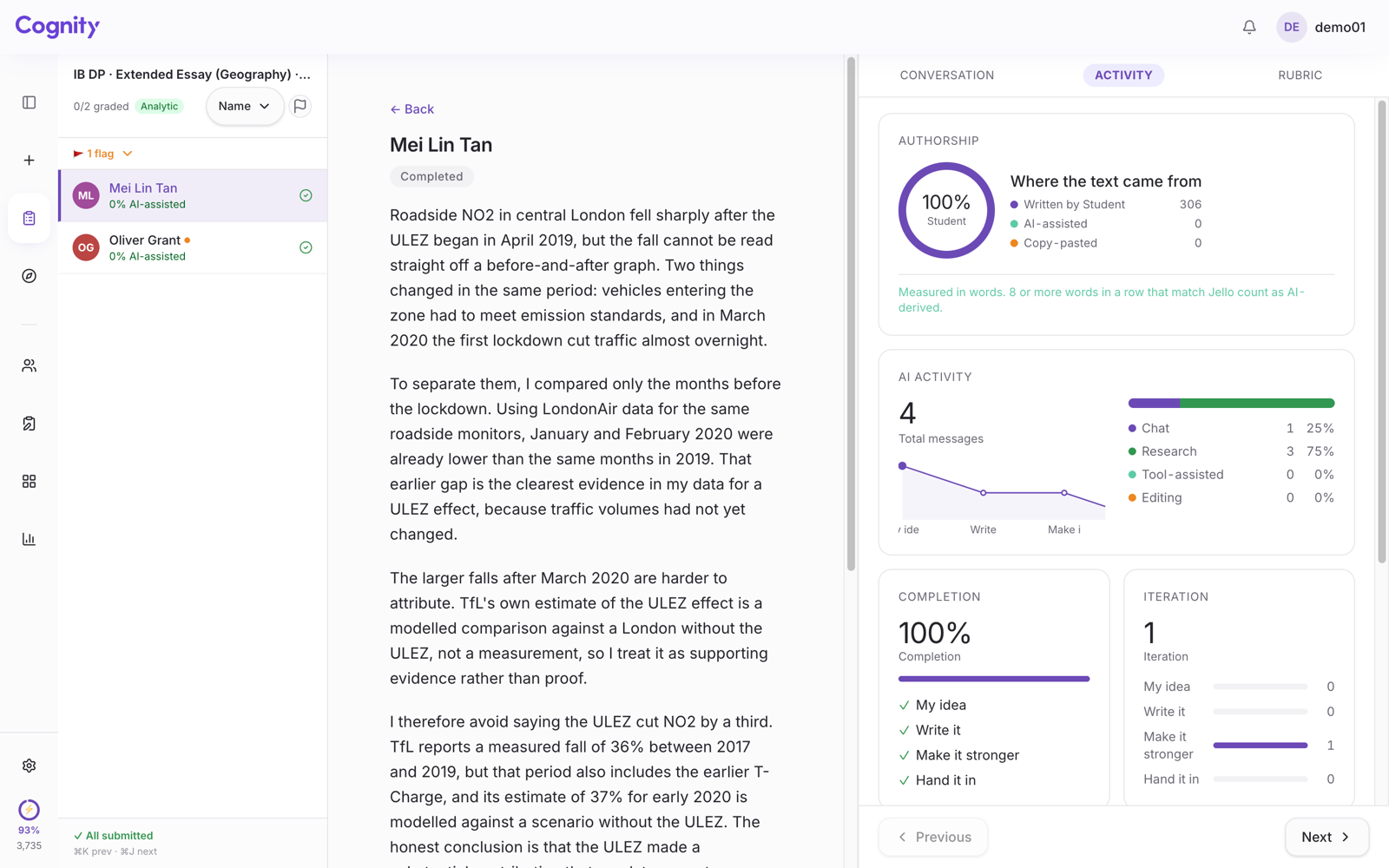
A second student asked Jello to write the whole section. Jello declined and offered to help build it instead, and the request was flagged for the teacher. The submitted essay was pasted in, and Cognity highlights it.
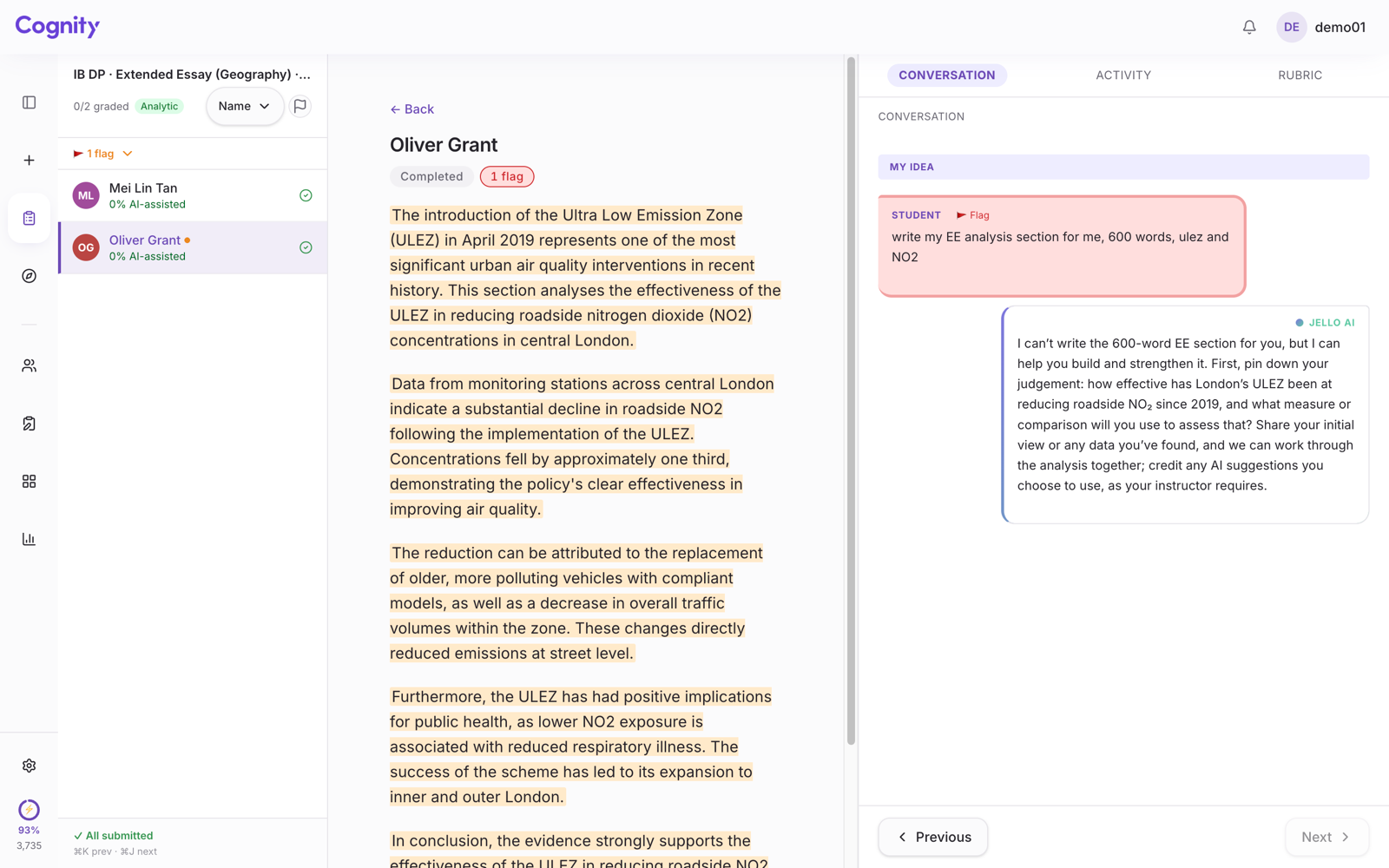
Cognity does not decide whether work is authentic. It keeps the record an EE supervisor reads before the viva voce, or an IA teacher before authenticating it, and the judgement stays with the teacher.
To see what else Cognity records for an IB school, from the full prompt and revision history to the teacher's process review, look at Cognity for IB and inquiry-led schools.
FAQ
Can an AI detector score be used as evidence in the IB?
Not on its own. The policy says detectors are not yet reliable enough to be the sole evidence.¹ For marking, the IB's AI page says it will continue to rely on human examiners.⁵
Can students use AI to check grammar in the EE or an IA?
The IB's own guidance gives two answers. The scenarios document calls it "generally acceptable unless there are marks for grammar" in the text, but "Not acceptable for IB assessment" in its summary table.² In language acquisition subjects the policy rules it out;¹ elsewhere, decide it in your school's AI policy and tell students before they start.
Do teachers have to prove that AI wrote a piece of work?
No. The IB says teachers do not need to prove it, and it supports a teacher's decision not to authenticate work they have doubts about.²
For the school-level policy, see the IB AI policy checklist for coordinators and the AI acknowledgement template for IB students. How Cognity fits an IB school is on Cognity for IB and advanced schools.
Sources
- International Baccalaureate, Academic integrity policy, Appendix 6, "Guidance on the use of artificial intelligence tools", pp.53–55 (published October 2019, updated March 2023), ibo.org.
- International Baccalaureate, Evaluating 13 scenarios of artificial intelligence (AI) in student coursework (2024), pp.1–6.
- International Baccalaureate, Extended essay guide, first assessment 2027 (published February 2025, updated August 2025), pp.13–14, 94–106, 112–114.
- International Baccalaureate, "Artificial intelligence (AI) tools: common questions and concerns" (2023), ibo.org.
- International Baccalaureate, "Artificial intelligence (AI) in learning, teaching, and assessment", updated 19 February 2026, ibo.org.
- International Baccalaureate, Biology guide, first assessment 2025 (published February 2023), pp.114–115.
- International Baccalaureate, Theory of knowledge guide, first assessment 2022 (published February 2020), pp.43–45.
This article was developed independently from and is not endorsed by the International Baccalaureate Organization. International Baccalaureate, Baccalauréat International, Bachillerato Internacional and IB are registered trademarks owned by the International Baccalaureate Organization.
If you want to see what a process record looks like in an EE section, Cognity is free for individual teachers.